Imagine you’re steering a large ship that’s been sailing reliably for decades but is now struggling in faster, more turbulent waters. The engine is outdated, repairs are costly, and new routes demand agility the old vessel just can’t provide. That’s the reality for many organizations with custom legacy applications—monolithic systems built on aging technology that power critical operations but hinder innovation, scalability, and security. Application modernization isn’t about abandoning the ship; it’s about thoughtfully upgrading it while keeping it afloat, delivering value along the way.
As a Solutions Architect in 2026, your role is to chart this course. Success hinges on seven interconnected decisions that balance technical excellence with business realities. These choices aren’t made in isolation—they cascade into one another, influencing cost, risk, timeline, and ultimate outcomes. What follows is a narrative exploration of these decisions, drawing from current industry practices, real-world examples, and proven frameworks. We’ll walk through each one conversationally, exploring the why, the options, the trade-offs, and practical ways to evaluate them, so you can apply this thinking directly to your own modernization journeys.
The Foundation: Choosing Your Overall Modernization Strategy with the 7 Rs
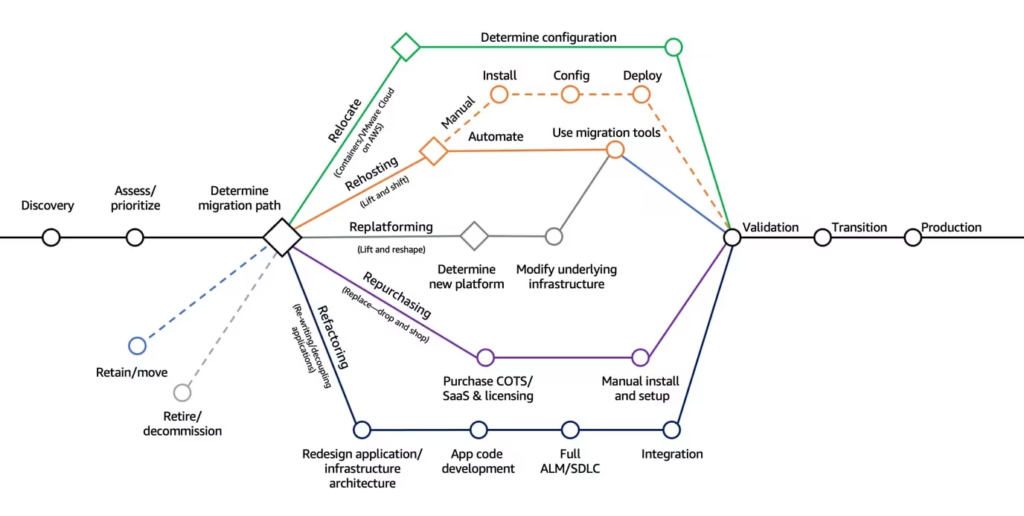
Every modernization effort begins with a fundamental question: How aggressively do we transform this application? The most widely used framework for answering this is the “7 Rs,” a spectrum of strategies that range from minimal disruption to full reinvention. Originally expanded from Gartner’s earlier models, it’s now a staple in guidance from AWS, Microsoft, and IBM.
Picture the 7 Rs as a ladder of ambition. At the lower rungs, you have rehost (often called “lift-and-shift”), where you move the application to the cloud virtually unchanged—quick and low-risk, ideal for gaining immediate infrastructure benefits like better availability. Moving up, replatform involves targeted tweaks, such as switching to managed databases, to unlock more cloud value without rewriting code. Refactor or rearchitect takes you into deeper transformation, breaking the monolith into microservices or serverless components for true agility. Then there are repurchase (switching to SaaS equivalents), relocate (moving hypervisor workloads intact), retain (leaving it as-is for now), and retire (decommissioning low-value apps).
In practice, most organizations in 2026 don’t pick one R for everything. They start with rehost or replatform for the bulk of their portfolio to capture quick wins—often reducing costs by 20-30% and improving resilience—then selectively refactor high-impact applications. This hybrid approach minimizes big-bang risks while building momentum. For instance, many enterprises use AI-powered assessment tools to automatically categorize workloads across the 7 Rs, making the initial portfolio analysis faster and more objective.
The beauty of this framework is its flexibility, but the danger lies in misalignment: choosing refactor too early can balloon budgets and timelines, while sticking forever with rehost leaves untapped potential on the table. To decide thoughtfully, rate your application on a simple 1-10 scale across key factors—how urgent is time-to-value (higher scores favor rehost), how critical are future scalability needs (pushing toward refactor), what’s the available budget and team skill level, and are there regulatory constraints forcing retain or retire? Higher totals lean toward transformative strategies.
This decision sets the tone for everything else, which is why it’s consistently cited as the most consequential. For deeper dives, AWS’s prescriptive guidance on the 7 Rs (https://docs.aws.amazon.com/prescriptive-guidance/latest/large-migration-guide/migration-strategies.html), IBM’s insights (https://www.ibm.com/think/insights/7-rs-cloud-migration), and Microsoft’s cloud adoption framework (https://learn.microsoft.com/en-us/azure/cloud-adoption-framework/plan/select-cloud-migration-strategy) remain essential reading.
Shaping the Future: Deciding on Target Architecture and Decomposition
Once you’ve chosen your strategy, the next natural question flows in: What should the modernized application actually look like? Legacy systems are typically one large, intertwined block—a monolith that’s hard to change without affecting everything. Modern architectures aim for modularity, allowing teams to innovate faster and scale independently.
You might evolve toward a modular monolith first, organizing the existing codebase into clearer internal boundaries while keeping it as a single deployable unit. This delivers maintainability gains with lower operational overhead. Or you could decompose into microservices, aligning services with business domains for true independence. Event-driven designs, where components communicate asynchronously through events, excel in real-time scenarios, while serverless approaches minimize infrastructure management entirely.
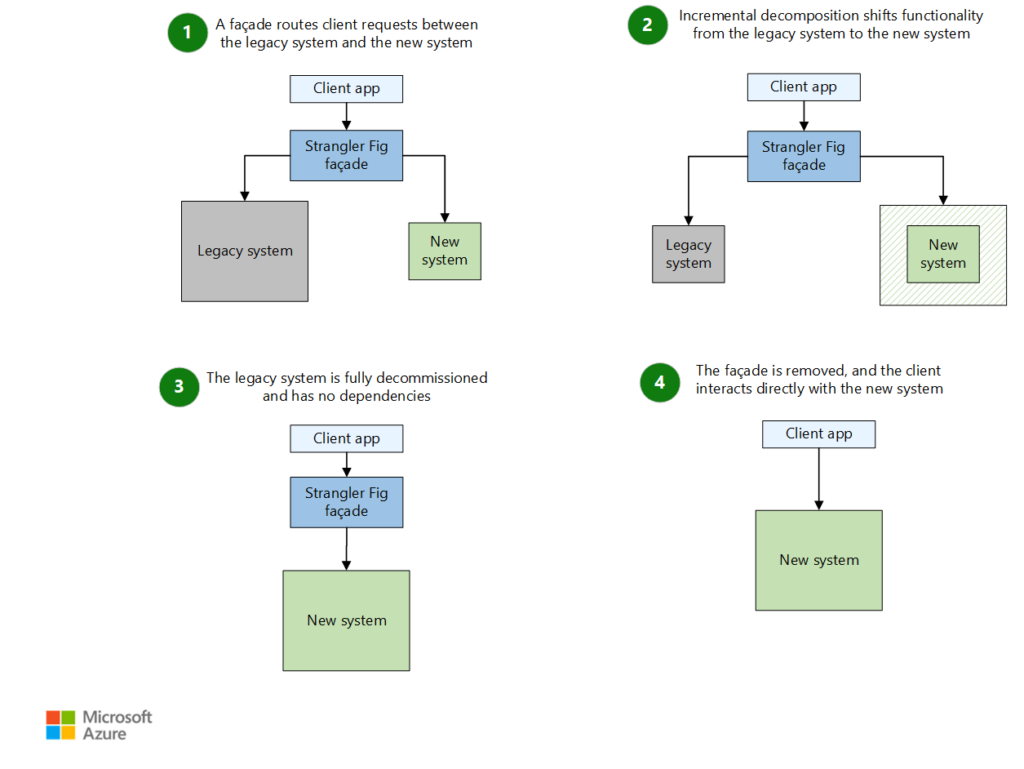
The gold-standard technique for safe decomposition is the Strangler Fig pattern, named after vines that gradually envelop and replace host trees. Pioneered by Martin Fowler (https://martinfowler.com/bliki/StranglerFigApplication.html), it involves building new functionality alongside the old system, routing traffic incrementally through a facade until the legacy core is fully replaced. This avoids the terror of big-bang rewrites and allows continuous delivery of value. Many teams combine it with domain-driven design to identify natural boundaries.
In 2026, AI tools increasingly automate boundary detection, but human judgment remains key to avoiding “distributed monoliths”—microservices in name only, still tightly coupled. Organizations often start modestly with modular monoliths before extracting services where the payoff is clearest, such as revenue-critical paths needing frequent updates.
To evaluate your path, consider your team’s velocity needs, the number of parallel developers, traffic variability, and tolerance for distributed-system complexity. Score these factors 1-10; higher aggregates suggest bolder decomposition. Thoughtworks’ series on embracing Strangler Fig (https://www.thoughtworks.com/en-us/insights/articles/embracing-strangler-fig-pattern-legacy-modernization-part-one) and Microsoft’s architecture center pattern guide (https://learn.microsoft.com/en-us/azure/architecture/patterns/strangler-fig) provide excellent real-world context.
Home Sweet Cloud: Selecting Your Provider and Platform
With strategy and shape in mind, where will this new architecture live? The big three—AWS, Azure, and Google Cloud—dominate, each with distinct strengths in 2026.
AWS offers the broadest service catalog and global scale, making it the go-to for highly custom workloads. Azure shines in hybrid scenarios and deep Microsoft ecosystem integration, while Google Cloud leads in AI/ML capabilities and data analytics. Market dynamics remain stable—AWS around 30-32% share, Azure 23%, Google 12-13%—but multi-cloud adoption exceeds 70% as organizations hedge against lock-in and optimize costs.
The choice profoundly influences subsequent decisions: service availability, pricing models, compliance features, and even team hiring. Many now evaluate hybrid tools like Azure Arc or Google Anthos early. To decide, weigh your existing skills, current software stack, AI priorities, cost transparency, and data sovereignty needs on a 1-10 scale per provider—the highest alignment wins.
Recent comparisons from Northflank (https://northflank.com/blog/aws-vs-azure-vs-google-cloud) and Pilotcore (https://pilotcore.io/blog/aws-vs-azure-vs-google-cloud-comparison) offer detailed technical breakdowns to inform your thinking.
The Heart of the Matter: Modernizing Your Data Strategy
Data is often the thorniest part of modernization—it’s sticky, regulated, and frequently the source of greatest risk. A poor data path can derail even brilliant architectural plans.
Options range from simple managed cloud databases to sophisticated polyglot persistence, using the best store for each workload (e.g., relational for transactions, document for flexibility). Event sourcing—capturing every state change as an immutable event paired with CQRS for separated read/write models—excels in audit-heavy domains. Emerging data mesh approaches decentralize ownership, treating data as domain-owned products.
Successful migrations emphasize zero-downtime techniques like change-data-capture and dual-write phases. Rate your needs for real-time analytics, consistency guarantees, regulatory constraints, and event-driven expertise to guide the choice. AWS’s guidance on data persistence in microservices (https://docs.aws.amazon.com/prescriptive-guidance/latest/modernization-data-persistence/welcome.html) and discussions around polyglot approaches provide practical starting points.
Fortifying the Perimeter: Embedding Zero-Trust Security
Modernization offers a rare chance to shift from perimeter-based defenses to zero-trust: never assume trust, always verify. Core tenets include modern identity providers, least-privilege access, continuous monitoring, and assuming breach.
In regulated industries, this decision can be make-or-break. Evaluate your current authentication maturity, regulatory burden, and workforce distribution to determine depth. NIST’s evolving guidance and Exabeam’s 2026 principles overview (https://www.exabeam.com/explainers/zero-trust/zero-trust-in-2026-principles-technologies-and-best-practices) are invaluable.
Seeing Clearly: Building Observability from Day One
Distributed systems are opaque without strong observability—unified metrics, logs, and traces. OpenTelemetry has solidified as the standard, enabling vendor-neutral instrumentation.
Best practices emphasize correlation across signals, intelligent sampling, and SLO-driven alerting. Assess your operations team scale and MTTR targets to size the investment. Resources like Sematext’s microservices instrumentation guide (https://sematext.com/blog/opentelemetry-instrumentation-best-practices-for-microservices-observability) help operationalize this.
The Journey Itself: Incremental Delivery with Strangler Fig
Finally, how do you execute? Big-bang rewrites historically fail spectacularly, while incremental strangler approaches dramatically reduce risk—often by 45-70% in incident rates. Build new capabilities alongside the old, shift traffic gradually, and retire legacy pieces only when safe.
This disciplined pacing ensures continuous business value and learning. Medium’s exploration of why strangler beats big-bang (https://medium.com/@ss_54118/the-strangler-fig-approach-why-incremental-modernization-beats-big-bang-rewrites-f88bb584390a) and Kai Waehner’s data-streaming case (https://www.kai-waehner.de/blog/2025/03/27/replacing-legacy-systems-one-step-at-a-time-with-data-streaming-the-strangler-fig-approach) illustrate the power of this mindset.
Bringing It All Together
These seven decisions form an interconnected journey, not a checklist. Document them in a concise charter tied to measurable outcomes—deployment frequency, cost per transaction, MTTR, feature lead time. Pilot on one application, measure relentlessly, and adjust quarterly. In 2026, with AI assistance accelerating assessments, human ownership of these architectural choices remains the difference between stalled initiatives and transformative success.
Modernization is evolution, not revolution. Approach it with curiosity, pragmatism, and a steady focus on business value, and you’ll guide your organization into a more resilient, innovative future.